

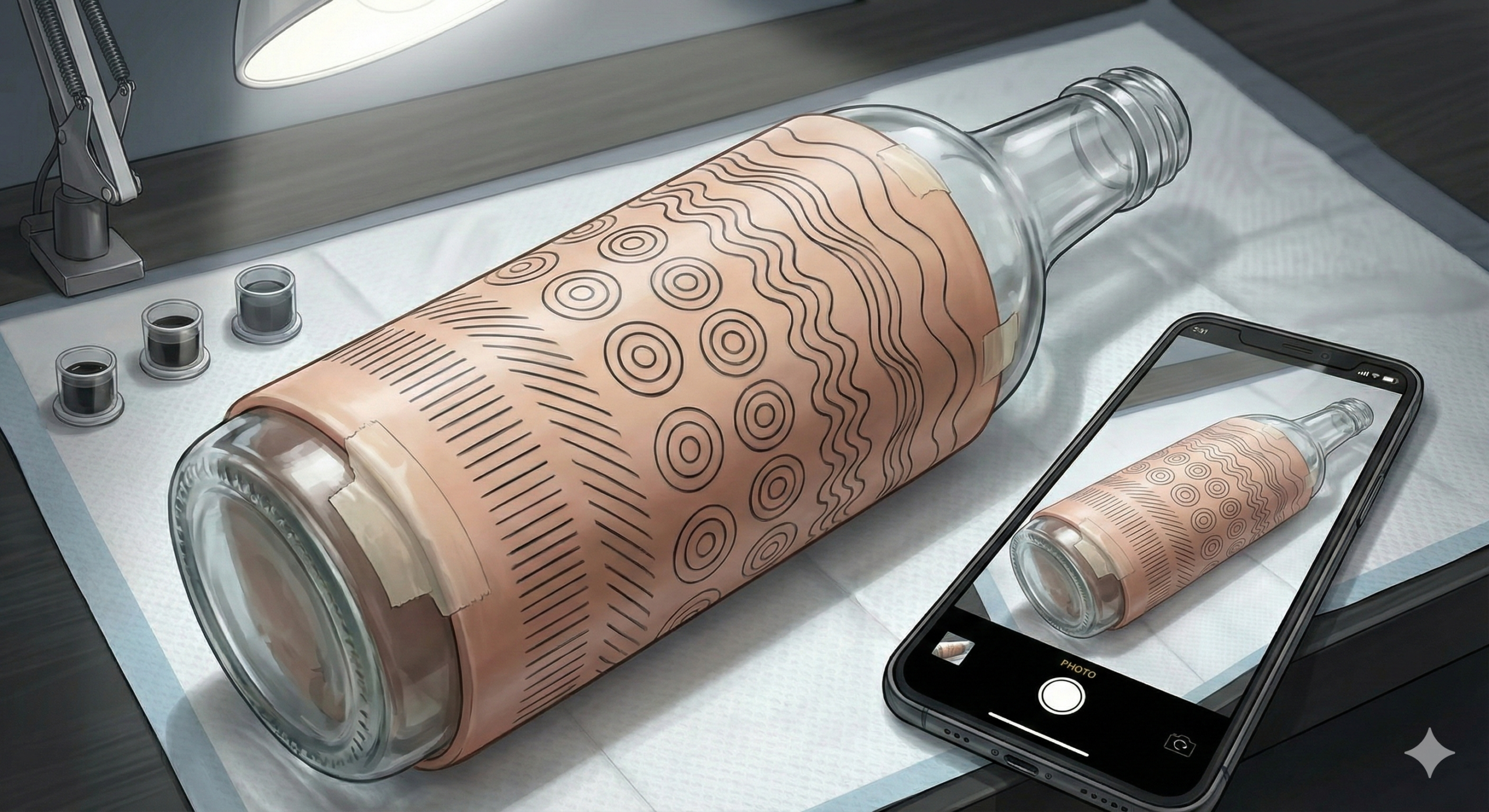
So you’ve got a tattoo machine, a stack of practice skins, and a head full of ideas. Now what? Before you ever touch a real client, fake skin is where your skills get built — or broken. Here’s everything you need to know to make the most of your practice sessions.
Why Fake Skin Actually Matters
A lot of beginners treat fake skin like a throwaway step — something to rush through on the way to “real” tattooing. That’s a mistake. The habits you build on fake skin are the habits you’ll carry onto real clients. Sloppy technique on practice skin becomes sloppy technique on people.
That said, fake skin isn’t a perfect substitute for human skin. It doesn’t bleed, it doesn’t move the same way, and ink behaves slightly differently in it. Gray wash won’t lighten the way it does under real skin. Blowouts don’t show up like they would on a person. Keep that in mind — the goal isn’t to master fake skin specifically, it’s to use fake skin as a tool to master tattooing in general.
What You’ll Need
Before your first practice session, get these sorted:
- Practice skin — Invest in quality. Thin, rubbery sheets feel nothing like real skin and will teach you bad habits. Look for thick, silicone-based options with genuine flexibility and ink absorption.
- Tattoo machine — Set it up exactly as you would for a real tattoo. Don’t cut corners on your machine settings just because it’s “just practice.”
- Stencil primer — A thick primer works best on fake skin, since thinner formulas tend to slide right off.
- Ink, needles, and Vaseline — Standard setup. Vaseline helps with wiping and keeps the surface workable.
- Paper towels — You’ll use more than you think.
- Gloves — Always. Even without blood, get into the habit now.
Setting Up Your Station
Treat your practice space like a real tattoo station. This isn’t just about cleanliness — it’s about programming your muscle memory. When you eventually work on real clients, the setup should feel completely automatic.
Lay a clean towel or mat over your work surface. Make sure your lighting is strong and positioned to minimize shadows over your work area. Have everything within arm’s reach before you start, because mid-tattoo fumbling is a habit you don’t want.
Transferring the Stencil
This step trips up more beginners than almost anything else.
Apply a thin layer of stencil primer (or deodorant — an old-school trick that works surprisingly well on fake skin) to the area you’ll be tattooing. Press your stencil paper down gently and evenly. The paper may look wet against the skin. That’s fine.
Here’s the part people skip: let it dry completely. On fake skin, this can take anywhere from 20 minutes to overnight depending on your primer and the skin’s surface. If you rush it, the stencil smears the moment your machine touches it, and you’ll be guessing where your lines should go. For best results, press a flat, heavy object over the stencil while it dries.
Tattooing: How to Actually Do It
Stretch the skin. Even though fake skin doesn’t technically need stretching, practice it anyway. Use three points of contact — your machine hand plus two fingers — to stabilize and tension the surface just like you would on a real body part. This trains your hands for the real thing.
Start from the bottom and work up. This prevents your machine and wiping hand from dragging through your stencil as you go. If you start at the top and work down, you’ll smear your own guide. Start at the bottom, always.
Focus on line work first. Don’t try to learn lining, shading, and color all at once. Nail your line work before you move on. Clean, consistent lines are the foundation of every style of tattooing. If your lines are shaky or inconsistent, shading on top of them won’t save the piece.
Go slightly deeper than you think. Fake skin tends to be more forgiving than real skin, and ink can sit near the surface without actually setting in. You may need a touch more depth than you’d use on a person — but be careful not to overwork the surface.
Wipe away from your stencil. Every time you wipe, drag the paper towel away from the stencil lines rather than across them. Vaseline on the surface helps keep ink flowing cleanly between wipes.
Practice Techniques That Actually Improve Your Skills
Don’t just tattoo random designs over and over. Deliberate practice beats repetition every time.
Do line drills — straight lines, circles, curves. Fill a whole sheet with nothing but clean, parallel horizontal lines, then diagonal ones, then wavy ones. Boring? Yes. Effective? Absolutely.
Wrap your fake skin around a curved surface — a bottle, a paper towel roll, even your own leg. Flat practice is fine for basics, but real bodies are never flat. Getting comfortable with curvature early will save you a lot of adjustment later.
Photograph your work after every session. Keeping a record of your practice pieces over weeks and months shows you exactly how you’re improving — and where you’re stalling.
Common Mistakes to Avoid
- Overworking an area. If the surface starts to break down or tear, you’ve gone over it too many times. On real skin, this causes serious damage. Build the habit of getting it right in fewer passes.
- Wiping too aggressively or too often. This smears your stencil and wears down the surface faster. Wipe deliberately, not anxiously.
- Using cheap practice skin. Thin, hard rubber sheets don’t give you useful feedback. If the skin feels more like erasing than tattooing, find a better product.
- Ignoring your machine setup. Don’t adjust your settings for fake skin in ways you wouldn’t for real skin. Practice exactly as you’d perform.
Cleaning and Reusing Your Practice Skin
Fake skin is reusable, so don’t throw it away after one tattoo. The most effective cleaning method is straightforward: apply a generous amount of Vaseline over the entire tattooed area, rub it in, then wipe it off with a dry paper towel. Repeat until the skin is clean. Avoid harsh soaps or alcohol — they can dry out and degrade the silicone.
Store cleaned practice pieces flat, away from direct sunlight and dust. If you want to keep a finished piece long-term, some artists seal their fake skin work under a layer of clear art resin to preserve it permanently.
One Final Note
Clocking hours on fake skin is valuable, but it’s not a finish line. Fake skin doesn’t replicate every challenge of working on real people — the movement, the nerves, the responsibility. When the time comes to make that transition, approach real skin with as much humility as you brought to your very first practice sheet. The learning never really stops.