

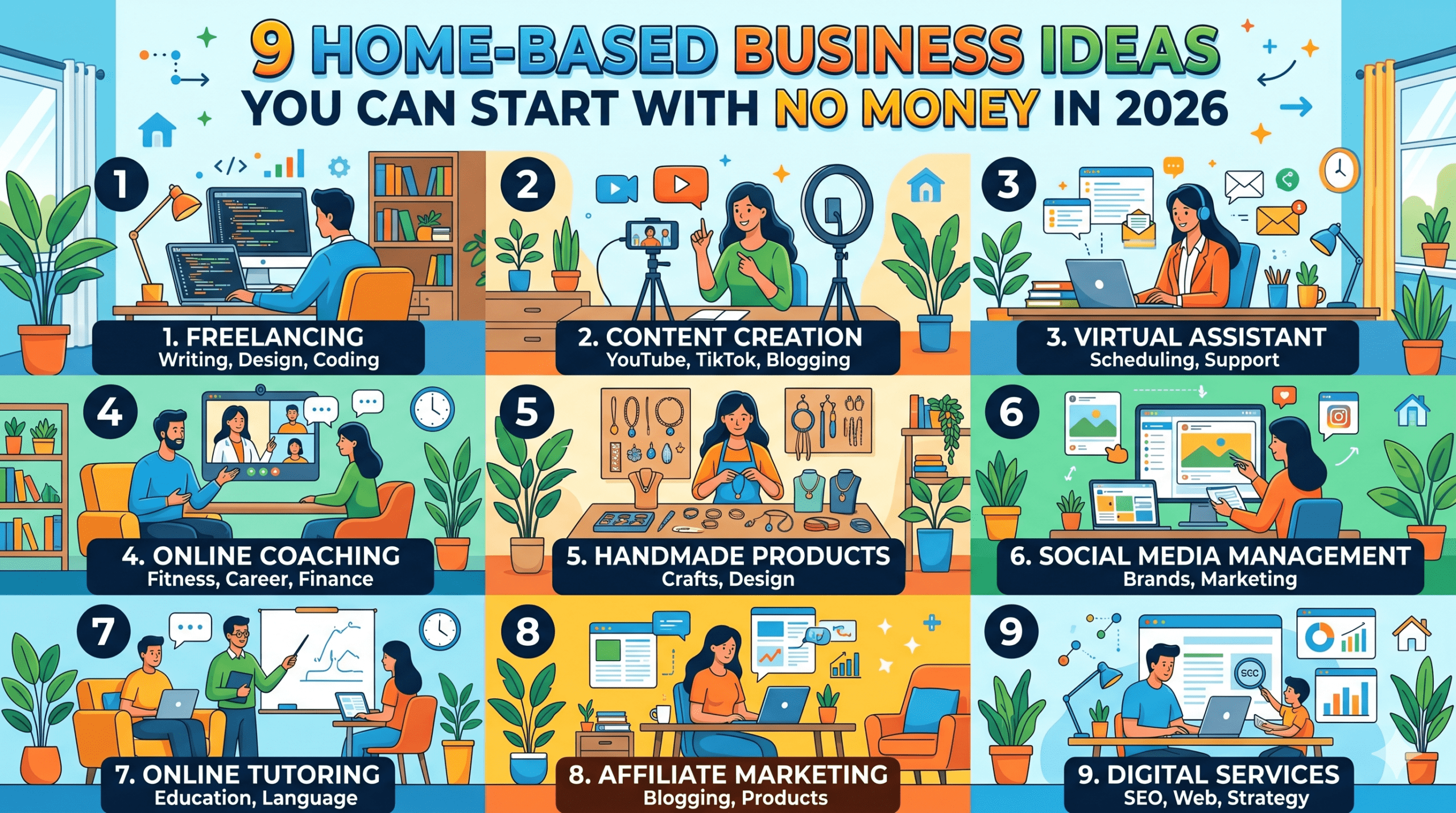
Want to work for yourself without spending a dime upfront? These nine home-based business opportunities require zero startup capital — just skills, time, and a laptop.
You don’t need savings, a loan, or an office to start a business anymore. As remote work has gone mainstream and free online platforms have multiplied, launching a home-based business with no startup cost has shifted from a nice idea to a realistic plan you can act on this week.
This guide breaks down nine legitimate, no-cost business ideas — what each one is, who it suits, exactly where to start, what you can realistically earn, and one tip to get your first client or sale faster. No fluff, no “buy my course” pitch.
Why start a home-based business with no startup cost?
A zero-cost business removes the single biggest reason people never start: financial risk. If an idea doesn’t work, you’ve lost time, not money — which means you can test several until one sticks.
Working from home also carries practical perks beyond flexibility. In the U.S., once your business earns income, the IRS lets eligible self-employed people deduct legitimate costs such as a home-office expense, a portion of internet and phone bills, and certain health insurance premiums. (Rules change yearly, so confirm current deductions with the IRS or a tax professional before filing.)
The catch with “no startup cost” is simple: what you don’t pay in cash, you pay in effort. Every idea below trades money for skill and consistency. That’s the deal.
The 9 best no-cost home-based business ideas
1. Freelance writing and copywriting
If you can write clearly, businesses will pay you. Freelance writers produce blog posts, website copy, newsletters, product descriptions, and SEO articles for clients who’d rather outsource it.
- Best for: Anyone with strong writing skills in any language; subject-matter experts who can explain things simply.
- Where to start: Upwork, Fiverr, Contra, and LinkedIn. Pitch directly to small businesses and niche blogs.
- Realistic earnings: Beginners often charge $0.05–$0.15 per word; experienced specialists charge $0.30+ per word or flat project rates of $300–$2,000+ per article.
- Quick tip: Write three sample pieces in your target niche and publish them publicly. A portfolio beats a résumé in freelance work.
2. Virtual assistance
Virtual assistants (VAs) handle the admin work business owners don’t have time for: email triage, calendar management, data entry, customer support, scheduling, and light research.
- Best for: Organized, reliable people who are comfortable with everyday software (email, spreadsheets, shared docs).
- Where to start: Belay, Time Etc, Fancy Hands, and direct outreach to overwhelmed solopreneurs on LinkedIn.
- Realistic earnings: $15–$40 per hour, rising with specialized skills like bookkeeping or social media.
- Quick tip: Pick one niche (real estate agents, coaches, e-commerce sellers). A specialized VA charges more than a generalist.
3. Online tutoring and teaching
From guitar lessons and exam prep to coding and conversational English, you can monetize what you already know by teaching it online — no rented classroom required.
- Best for: Anyone with expertise or a skill others want to learn; native or fluent speakers of in-demand languages.
- Where to start: Wyzant, Preply, and Cambly for tutoring; create a profile and teach live sessions over video.
- Realistic earnings: $15–$60+ per hour depending on subject and demand; specialized test prep and technical subjects pay most.
- Quick tip: Record one short “intro” video showing your teaching style — it converts far better than a written bio.
4. Affiliate marketing
You recommend a product through a unique tracking link, and when someone buys, you earn a commission — without holding inventory or building a store.
- Best for: People who already create content (blogs, YouTube, TikTok, newsletters) or are willing to start.
- Where to start: Amazon Associates, ShareASale, Impact, and most major brands’ own affiliate programs (all free to join).
- Realistic earnings: Highly variable — from a few dollars to four figures a month — and it builds slowly. Income follows audience trust.
- Quick tip: Only promote products you’d recommend to a friend, and write genuinely useful comparison content. Honest reviews convert; spammy links don’t.
5. Print-on-demand design
You upload a design; a partner prints it on a t-shirt, mug, or tote and ships it to the customer. You never touch inventory or pay until something sells.
- Best for: Anyone with a creative eye; you can start with free design tools even without pro software.
- Where to start: Redbubble, Teespring (Spring), and Printful. Free design via Canva or Inkscape.
- Realistic earnings: Small per-item margins ($2–$8); volume and a sharp niche matter more than any single design.
- Quick tip: Design for specific micro-communities (e.g., “left-handed cat owners”) rather than generic slogans — niche buyers search harder and convert better.
6. Sell handmade goods and digital products
Turn a craft or a skill into products. Physical handmade items work if you already own the materials; digital products (templates, printables, e-books, presets) cost nothing to duplicate after you make them once.
- Best for: Crafters, designers, and anyone who can package knowledge into a downloadable file.
- Where to start: Etsy and Gumroad. Digital products are the closest thing to true zero-cost inventory.
- Realistic earnings: Digital products scale well — make once, sell infinitely. A single $12 template can earn for years.
- Quick tip: Start with digital, not physical. No shipping, no materials, no stock — pure margin.
7. Stock photography and video
License your photos and clips to buyers who need quality visuals. Each download earns a royalty, and one strong image can sell repeatedly for years.
- Best for: Photographers and videographers — even a good smartphone camera works for many categories.
- Where to start: Shutterstock, Adobe Stock, and iStock. Upload, tag well, and earn per download.
- Realistic earnings: A few cents to a few dollars per download; income compounds as your library grows.
- Quick tip: Shoot in-demand themes (remote work, diverse people, everyday business scenes) and use accurate, searchable keywords. Discoverability is everything.
8. Social media management
Small businesses know they need to post consistently but rarely have time. Managing their accounts — planning, writing, scheduling, and engaging — is a service you can run entirely from your phone and laptop.
- Best for: People fluent in one or more platforms (Instagram, TikTok, LinkedIn, Xiaohongshu, WeChat).
- Where to start: Pitch local businesses directly; free schedulers like Buffer’s basic plan let you manage clients without paid tools.
- Realistic earnings: $300–$2,000+ per client per month; two or three clients makes a meaningful income.
- Quick tip: Offer a free one-week content plan to your first prospect. Showing results beats describing them.
9. Bookkeeping and admin freelancing
If you’re comfortable with numbers and spreadsheets, small businesses will pay you to keep their books tidy — categorizing expenses, reconciling accounts, and preparing simple reports.
- Best for: Detail-oriented people; prior accounting exposure helps but isn’t mandatory for basic bookkeeping.
- Where to start: Free spreadsheet software to begin; offer services to local shops and freelancers who dread their finances.
- Realistic earnings: $20–$50+ per hour; clients tend to stay for years, creating stable recurring income.
- Quick tip: Recurring monthly retainers beat one-off jobs. Price for the relationship, not the task.
Quick comparison: which idea fits you?
| Business idea | Main skill needed | Speed to first income | Income ceiling | Recurring income? |
|---|---|---|---|---|
| Freelance writing | Writing | Fast | High | Sometimes |
| Virtual assistance | Organization | Fast | Medium | Yes |
| Online tutoring | Subject expertise | Fast | Medium–High | Sometimes |
| Affiliate marketing | Content / audience | Slow | High | Yes (passive) |
| Print-on-demand | Design eye | Medium | Medium | Yes (passive) |
| Handmade / digital products | Creativity | Medium | High (digital) | Yes (passive) |
| Stock photography | Photography | Slow | Medium | Yes (passive) |
| Social media management | Platform fluency | Medium | High | Yes |
| Bookkeeping | Numbers / detail | Medium | High | Yes |
How to choose the right one for you
Don’t try all nine. Pick based on three honest questions:
- What’s your strongest skill? Lead with what you already do well — you’ll get paid faster and quit less often.
- Do you want money now or money later? Freelance services (writing, VA, tutoring, bookkeeping) pay quickly. Passive plays (affiliate, print-on-demand, stock, digital products) pay slowly but compound.
- How much time can you commit weekly? Be realistic. Five focused hours a week on one idea beats one hour each on five.
Then commit to a single idea for 90 days before judging it. Most people fail not because the idea was bad, but because they switched too soon.
Frequently asked questions
Can you really start a business with no money? Yes. Every idea in this guide can be started for $0 using free platforms and skills you either have or can learn. You invest time and effort instead of cash.
What home business is the easiest to start with no experience? Virtual assistance and basic freelance services are the most beginner-friendly, because they rely on common skills (organization, communication, writing) rather than specialized training.
How long until a no-cost home business makes money? Service-based businesses (writing, tutoring, VA work) can earn within days to a few weeks. Passive-income models (affiliate marketing, stock photography, print-on-demand) usually take several months to gain traction.
Do I need to register a business to start? In many places you can begin as a sole proprietor without formal registration, but rules vary by country and region. Check your local requirements and confirm tax obligations once you start earning.
Which no-cost business has the highest income potential? Freelance writing, social media management, bookkeeping, and digital products scale the highest — the first three through higher rates and more clients, and digital products through sell-once-earn-forever margins.
The bottom line
A home-based business with no startup cost isn’t a shortcut to easy money — it’s a low-risk way to test whether working for yourself fits your life. The financial barrier is gone; the only real requirements are a marketable skill, a free platform to offer it on, and the discipline to stick with one idea long enough to see results.
Pick the option that matches your strongest skill, give it 90 focused days, and let your first paying client tell you you’re in business.